
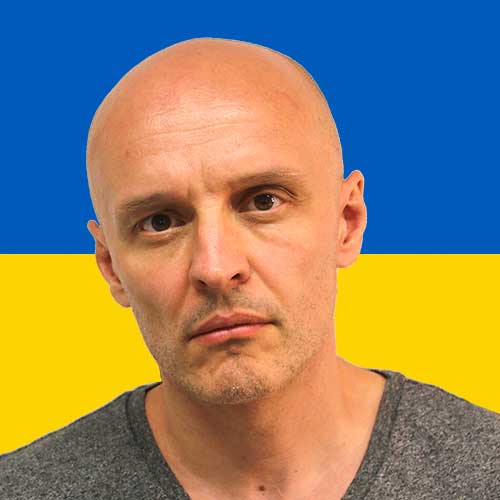
I was born in Kyiv, Ukraine. My father’s lineage came from Zhytomyr, while my mother’s traced back somewhere near Poltava. My grandmother didn’t like to talk much about her past—it was, evidently, quite difficult, and included experiences such as the Holodomor. Because of that, she was obsessively devoted to feeding every household member, especially the youngest, a group I was part of for some time.
Fate swept me to Moscow and handed me a Russian passport. I never asked for it, and to this day I still can’t forgive her for it. In my defense, I was moved there at a very young age, and truthfully, it wasn’t really me who was moved but rather my father, who was relocated to Moscow for work.
Already in school, I could sense that something was wrong with the country. I understood this on an intuitive level. Still, there was a kind of logic to my intuition. Having spent time with a few questionable groups of people, I came to realize that the only thing capable of uniting groups that are, by default, hostile toward one another, is something even more indecent than their usual business. Something like a revolution.
Watching footage from an old Soviet film depicting the storming of the Winter Palace, I clearly felt that the thoughts running through those armed individuals weren’t about the bright future of “liberated” workers and peasants. They were thinking about the coming hours—hours in which they’d loot a wealthy house. Of course, among them were some “idealists” trying to maintain order, but we now know perfectly well what those ideals ultimately lead to.
It would be naive to claim that the revolution shattered a kind of crystal palace that Russia once was. The country, with its rather dark past, was shaped in the consciousness of my generation largely by regime historians. Without going into detail, I’ll simply say that it’s not hard to grasp the direction of their efforts. At the same time, some historical facts can’t be hidden. For me, the most telling and symbolic trait of Russia’s historical arsenal has always been the Oprichnina, and the realization that a country ruled by figures like Ivan the Terrible, Peter the Great, Pavel II, or Stalin inevitably has a grim-looking future. And that’s not even considering Gumilev’s theory that the Rus', the people whose name modern Russians adopted, all drowned in the Mediterranean Sea.
To offer some comfort to Russians who are Russian not only by passport but also by ethnicity, I’d like to note, as a biologist, that nationality is not a sentence. It isn’t encoded in the genome, nor does it imply some obligatory set of human traits. If you take a small Russian child and toss them into the forest, they’ll grow up like Mowgli—leaping between branches and throwing bananas. But if you gently place them under a respectable doorstep somewhere in the suburbs of Oxford, you might one day find them a lord in Parliament. It all depends on upbringing.
In Russia, television raises children. For reasons difficult to explain, those who watch it don’t seem to grasp that the picture shown on screen bears little resemblance to reality. Instead, it reflects the worldview of the channel’s owner and their plans for the future. The specific influences that shape those moods aren’t especially relevant here. What matters is that the source of information—and control over it—should never be concentrated in one set of hands by default. It’s as if a school had only one slightly deranged teacher, who taught every subject by reciting the same nonsense, mostly fueled by his own childhood trauma. Attempts by his students to later present this rehearsed version of reality as truth can only provoke a smile from any thinking person.
What Russian schools absolutely do not teach is critical thinking—the need to question and verify every piece of information. This kind of verification should start by analyzing the reliability of the source. In modern Russia, though, the issue isn’t so much reliability as basic psychological adequacy.
Everything said above, in my view, is so painfully obvious it ought to be clear to anyone who’s mastered the multiplication table. Yet, here we are. Returning to my early understanding of Russian history from my school days, I must note that one of the main historical trajectories following the 1917 revolution was emigration. If you add to that the repressions and persecution of dissidents, the cumulative process can only be described as societal degradation. This process has continued throughout the years—sometimes fading into the background, only to resurface with renewed force. The most recent wave of emigration—namely the flight from the general mobilization of 2022—appears to be the final, climactic wave of migration from Russia. Because realizing the need to emigrate requires a certain amount of mental capacity, and judging by those who’ve stayed behind, it would seem that capacity is no longer present. Then again, there may be nowhere left to emigrate to, as most countries now refuse to host representatives of a terrorist state.
I’ve lived in Europe for over a quarter of a century. Leaving Russia was, perhaps, one of the wisest decisions of my life. From afar, I watched as Yeltsin ushered a small man with a disturbingly unpleasant face into the grand hall in 1999. When I heard him say “Let me introduce you to your new president,” I remember thinking, “Dear God, what a creep.” Learning of that individual’s KGB background, I knew with certainty: that was the end of it all.
Once, while on expedition in Borneo, where I was studying ants living in the canopy of tall trees, I came across a spherical web swarming with tiny spiders. At first, I thought it was a rare example of colonial spider behavior. But then, from deep within that bustling orb, emerged a massive, midnight-black she-spider with a teardrop-shaped abdomen. She descended on a thread, stopped right in front of my face, staring directly at me with all her eyes. After a second or two, she retreated and vanished back among her offspring. “Hello, Mister Putin,” I remember thinking
Like a spider, he sits at the center of his web, clutching in his pale, vengeful, and envious little claws the strands of control over the empire he’s woven. The sole purpose of this empire is the well-being of the main spider. The smaller spiders stand a chance at finding a cozy spot in the web, provided they fulfill a simple condition: unconditional recognition of the chief spider’s central place in the nest. The more unconditional the recognition, the cozier the spot they’re granted. The system is fairly simple, precisely because it doesn't include that bothersome aspect called morality—power and money are much easier to wield without it.
Another trait of this spider colony is that the closer one gets to the center, the larger the spiders become. The fatter the spider, the more valuable it is to spider number one—for he is, in truth, a cannibal.
But then the chief decided his web was too small. So he tried to expand it, wrapping it around a neighboring branch. From the center of his web, he thought the creatures living on that branch were spiders too, and assumed dragging them into his net wouldn't be much trouble. That turned out to be his fatal mistake. The neighboring branch was home to leafcutter ants—with powerful mandibles that deliver painful bites and who categorically refuse to mingle with spiders.
It also soon became clear that being a spider isn’t all that advantageous. For as a spider, you can only live among other spiders. And spiders, as it turns out, aren’t even the majority of the forest’s population. So when the big spider tumbled out of his web, he found himself face to face with the rest—non-spider neighbors who weren’t the least bit happy to see him.
Now that the chief has been smacked on the nose, the other eight-legged ones are beginning to ponder whether something ought to change in the web. But it's not so easy. Everything here is so entangled that if you pull the wrong thread, it tightens around your neck like a noose. Who will dare take the first step? Who will have the courage to say that the king is not a king, but merely... an old, sick spider rapidly losing grip? Most likely—no one.
Now let’s speak of the tiniest spiders—the common folk of the web, so to speak. For quite a while, many held out hope that things weren’t so bleak. They believed that among those weak-willed and feeble creatures clinging to the outer edges of the web and desperately trying to crawl toward the feeder, there might exist representatives of other classes. However, as events in recent months have shown, nearly all of them are spiders—just very, very tiny ones.
The extremely small size of these spiders is the result of a long and meticulous process of selective breeding—executed with the rusty guillotine of Russian justice. Only the most pitiful survive: those so minuscule that the width of their heads perfectly matches the notches of the blade, allowing them to pass through unnoticed—even when something occasionally slams down overhead. Still, living in a country where all questions are settled by guillotine is relatively simple. One merely has to follow one rule: never raise your head and never—under any circumstances—possess an opinion that differs from the spider orthodoxy.
And how skillfully these spiders managed to masquerade as butterflies! In nature, that kind of mimicry would take thousands of years of evolution. Yet Russian spiders mastered it in mere decades by draping their coarse, hairy limbs with the bright, decorative fashions of the West. Had it not been for the chief spider’s reckless escapade, the world might’ve remained blissfully ignorant of their true nature for many years.
Setting metaphors aside, let’s put it plainly. What we’re witnessing is the evolution of Russian society—a process involving the mass alienation of everything that retains a sense of self-worth. It’s a systematic, intentional, and inevitable descent into vulgarity. It’s unlikely that Lenin, Marx, or Engels laid out this path in their dusty volumes, but within this particular community, total vulgarity seems not only an outcome—but a distinct and, regrettably, final goal.
Vulgarity here exists at all levels. And make no mistake: this is not some middle stage of social development. If it were merely average, things wouldn’t be quite so dire. No—this is the highest cultural level of the modern Russian, expressed vividly through figures like the country's president and its foreign minister. And as for individuals on the level of Kadyrov or Prigozhin? Vulgarity makes decisions, governs the country, administers justice, writes laws, and attempts to manage the economy.
So what, then, constitutes the lowest level of development in this society? That can currently be observed without issue from the trenches in Ukraine.
Russian vulgarity is deprived of any sense of personal dignity. In its place sits a deep-rooted fear of authority. It’s truly astonishing—this fear is so all-consuming that people are ready to march to certain death, just to avoid defying those sending them there. And if exceptions to this rule do arise, the system has a sharpened mechanism to swiftly eliminate them.
A few words about Russia itself. To be honest, a lowercase “r” more than suffices. And that, of course, is quite enough to put it in its place. What’s needed are HIMARS, guided by the steady hand of a Ukrainian artilleryman.
Studying Russia’s history, one gets the impression that the country has always been propelled by some grand idea. Yet any attempt to grasp the essence of that idea inevitably ends in failure. Upon inspection, it seems the central idea of Russia is simply its own name. In other words, the only comprehensible ideological proposition Russia offers is that Russia should exist. Why, and to what end? No one seems capable of explaining.
Let’s conduct a thought experiment. Imagine that one fine morning, Russians wake up to find that Russia no longer exists, and the place where they’ve awakened is now part of, say, Switzerland. Do you think they’d be terribly upset? To answer that, we need to ask: what exactly would they have lost in that moment? "Spiritual bonds"? Sadly, this magical metamorphosis isn’t destined to happen.
The country once had a chance to become something more than just a label on a piece of land. But all it managed to achieve was to become even more Russia than it had been before—whatever that may actually mean.
Now, about the war. Do you remember that old song lyric: “We are peaceful people, but our armored train…”? The phrase “We are peaceful people, BUT” reflects the psychological ferment in which the Soviet system was raised—because the song doesn’t glorify peacefulness at all. It glorifies the armored train.
On May 29th, 2017, Putin declared a “Decade of Childhood” in Russia. Dutifully slipping into childhood, Russia decided to play war games—and attacked Ukraine. Ukraine, unexpectedly to everyone, took this game seriously and responded to Russia’s toy army with real bullets, throwing it into total disarray.
What matters here is the word “peace,” because before launching the war, Russia spent several years insisting, with obsessive persistence, that it stood “Za mir!” (For peace).
One Hungarian acquaintance of mine—an avid weapons enthusiast—once showed me photos from his trip to Moscow on Victory Day. It was 2017, and by then I'd lost any clear idea of what the modern capital of Muscovy looked like. What struck me most in those photos wasn’t the skyscrapers rising over the Moscow River, but the chocolate hand grenades—yes, actual grenade-shaped chocolates—lining bakery shelves alongside edible Kalashnikovs and Maxim machine guns. Scratching my head, I remember saying, “You know, I think Russia is preparing for war…” And then came 2023, and the chocolate army began melting in Ukraine—despite the Epiphany frost.
But why does Russia crave war so much? In my view, it’s because war is the simplest form of statecraft. It preys on the latent hostility people feel toward other groups. All you need is to invent an enemy and convince your population that this enemy is real. Lacking imagination, you can even appoint the entire outside world as the enemy—or just the Western part of it.
From there, things are easy: in the name of war, sacrifice democracy, free speech, the economy. Blame the enemy for every mortal sin, and so on. This way, those in power can rest assured that the masses will search for the source of their misery not in government offices—but across the 7/8ths of the planet that are mercifully free of Russia.
In my view, Russia’s deepest affliction lies in its punitive apparatus—all those institutions like the KGB, NKVD, FSB, OMON, the National Guard, and other executioners. The unjustified romanticization of the KGB and similar organizations has always played a cruel joke on the population. These entities are now perceived as something “morally ambiguous but necessary,” rather than what they truly are—terrorist organizations.
This leads directly to the problem of Russia’s future, or rather, the question of whether it even has one. Because if the world grants Russia a future, it must be prepared to contend forever with the sting hidden within the body of this demoness. Then again, aside from that sting and a heap of filth, there’s virtually nothing inside her at all—at least, nothing of her own.